A fractional CMO case study from inside a trading-software company.
Before I started working with FX Replay, one of their agencies spent over $15,000 in ad budget and brought back fewer than five subscribers.
That is a customer acquisition cost many times what each customer would ever pay back over their lifetime. Nobody caught it for months, because nobody could see it.
FX Replay is a SaaS platform traders use to backtest their strategies against historical market data. When I arrived in early 2025, the product had real pull: roughly 20,000 signups a week, most of them organic, on mid-seven-figure ARR.
The mandate I aligned on with the founders was direct. Double revenue.
Eighteen months later, ARR stood 2.6x higher.
The diagnosis
I spent my first weeks ignoring the channel dashboards and asking why decisions were being made the way they were.
Event tracking and attribution had been broken for two or three years. The ad platforms could see a signup and nothing after it. No trial, no payment, no revenue.
Every platform told a different story, internal reporting told another, and finance believed none of them. The agency that burned $15K was never confronted with clean evidence, because the data couldn't produce any.
Years of bad data had shaped the whole organization's behavior. Paid budgets shrank because nobody could defend them. Email was treated as a service desk that existed to send receipts and password resets.
Smart people kept making the rationally safe choice: spend less, test less, believe less.
So the work had to run in a specific order. First make the numbers trustworthy. Then use them to find the lever that doubles revenue. Then build the team and operating rhythm to pull it.
You can't scale spend on numbers nobody believes, and you can't delegate decisions to a team that has nothing reliable to decide with.
Move one: rebuild the measurement layer
The fix started embarrassingly simple: a standard event dictionary. Four events, defined once, used everywhere.
- Signup — account created
- Trial — trial started
- Subscribe — first paid subscription
- Purchase — every payment, including renewals and reactivations
The hard part was organizational. The fix needed backend engineering time that marketing didn't control, at a company where marketing had spent years earning skepticism.
I wrote the spec, made the case to the founders and product engineering, and stayed close while it got built: a server-side event fanout that fired every event from the backend to every destination at once. The ad platforms, the email platform, the affiliate system, the data warehouse, and one shared growth dashboard the whole team worked from.
Same event, same definition, same moment.
A problem the company had lived with for three years was gone in a quarter. It also bought marketing back its credibility inside the building, which I would need for everything that followed.
Move two: find the lever
Doubling ARR was the goal, and with 20,000 signups already arriving every week, demand was clearly sufficient. The lever had to be somewhere inside the subscriber base.
Once the pipeline gave us honest numbers, we pulled that base apart: who subscribed, on which plan, at what price, through which channel, and how long they stayed.
The churn analysis produced the finding that shaped the entire engagement: more than 90% of subscribers paid month to month.
Trading takes discipline, and month-to-month traders cancel the first time they step away from the markets. That churn set a hard ceiling on LTV, and no acquisition program can outrun a ceiling.
The economics pointed at annual plans. With the existing LTV as the floor a customer was already worth, we could discount the first annual year aggressively and still come out ahead, collect the cash upfront, and replace twelve cancellation decisions a year with one.
I partnered with finance to model the discount depth, built the pricing strategy around it, and backed it with upsell flows, churn-recovery flows, and purchasing-power-parity pricing tests in the international markets where a large share of signups originated.
Paid acquisition got reworked in parallel. For years the platforms had been fed signups, the only event the old tracking could see, so Meta and Google dutifully hunted the world's cheapest account creators.
Once campaigns optimized on the Subscribe event, LTV-to-CAC came in between roughly 4:1 and 15:1. That math justified scale: a high-six-figure budget redeployed across Google and Meta, with weekly CAC visibility by campaign and country.
Move three: build the team that pulls it
By December 2025 I had moved from consultant into the CMO seat, running a ten-person team: creatives, a web marketer, front-end developers, a lifecycle marketer, an affiliate manager, organic social leads, and a bench of on-camera trader talent.
My week revolved around a standing growth review on the shared dashboard, with every channel owner reading the same numbers, defending their own bets, and getting coached on the misses.
Email shows what that management layer produced. The organization saw it as a service desk. I made the case to leadership that a database heading past two million contacts was an unworked revenue asset, hired lifecycle talent to work it, and gave them targets and room.
Email grew from a few thousand sends a month to a program peaking near six million sends a month, holding a 26% open rate at that volume.
The same delegation pattern ran across the org. The affiliate manager scaled the partner program past 4,000 active affiliates, returning five dollars in revenue for every dollar paid out in commissions.
The creative team worked from a scoring system we built across a thousand-plus ad creatives, so winning concepts got iterated and losers got killed without me in the room.
The social leads and trader talent grew YouTube past a million views while organic search impressions more than tripled year over year. Three dozen A/B experiments across homepage, checkout, and pricing kept the machine learning between my check-ins.
Black Friday: the whole system in one campaign
Black Friday 2025 put all three moves into a single play.
Trusted data set the offer's floor, since we knew to the dollar how deep an annual discount could go and still clear LTV. The annual-plan thesis chose the offer. The team ran it through every channel at once: paid, lifecycle, affiliates, and organic, all pointing at the same offer with the same tracking underneath.
Black Friday week did 4.5 times the new-business revenue of a normal week, and the promotional architecture held the pace well above the old baseline through the New Year.
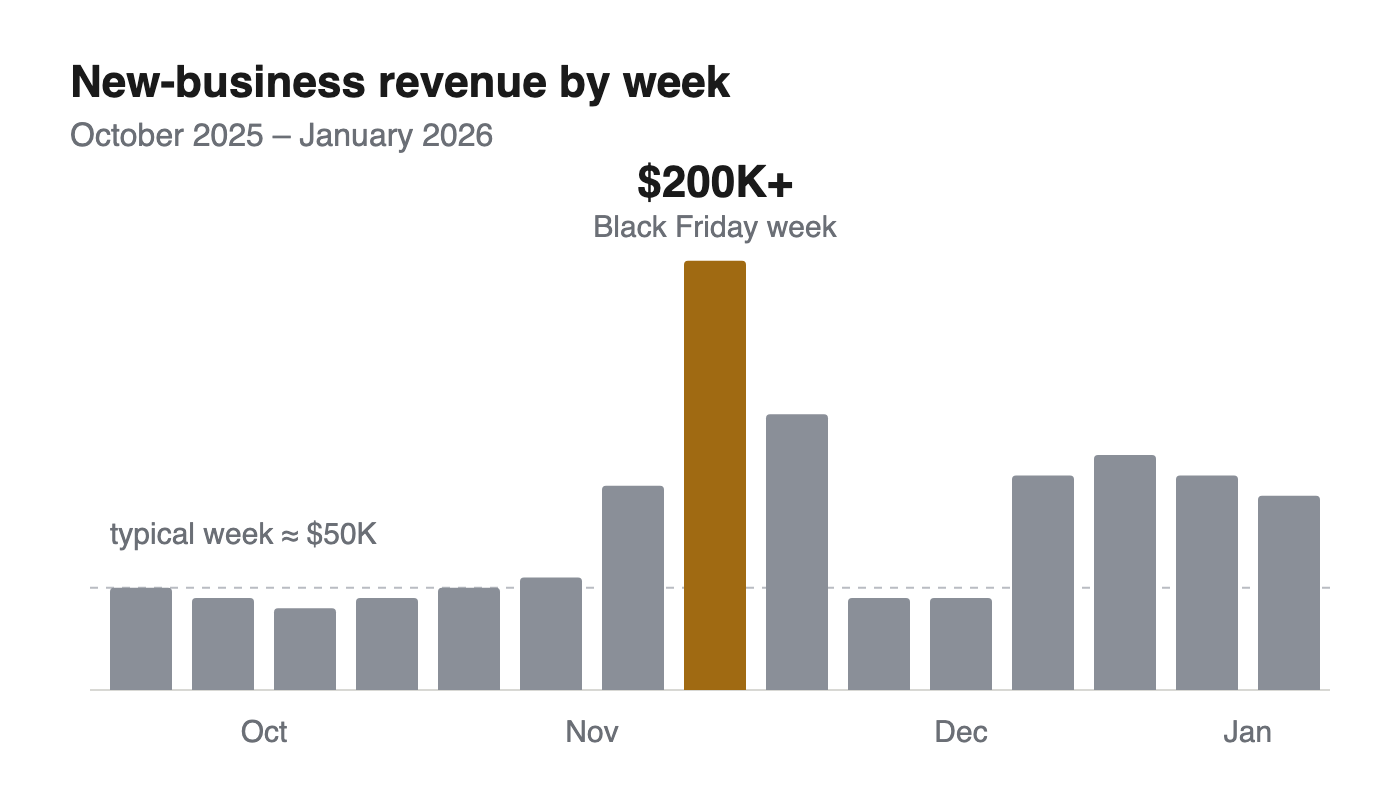
Q4 2025 closed with seven figures of new-business revenue, more than double the quarter I arrived to.
The results
- ARR grew roughly 2.6x in eighteen months.
- New subscribers per quarter rose 60% year over year.
- Trial-to-paid conversion improved from 16% to 21%.
- Paid LTV-to-CAC held between roughly 4:1 and 15:1.
- Q4 2025 delivered seven figures in new-business revenue, anchored by a Black Friday week that ran 4.5x the weekly baseline.
If this sounds familiar
Most companies that call me are some version of FX Replay in 2024: a product that sells, numbers that contradict each other, and a history of agency spend that made everyone gun-shy.
The sequence I ran here is the same one I bring to every engagement, a few at a time. Rebuild trust in the data, find the lever in the economics, build the team that pulls it. If your dashboard and your bank account disagree, let's talk.